
GTM Strategy
Product Marketing Ops
Revisual Labs had already built real credibility in information design and data storytelling. But their category was undefined, their messaging was fragmented, and their best work was hiding behind weak positioning.
In under 30 days, we built the strategic foundation they needed, from business strategy to brand narrative to a full website rewrite, so Revisual could finally communicate their value with the same clarity they bring to their clients' data.
Revisual Labs is an information design agency based in India. Their clients span media, public sector, academia, and corporate organizations. Their core work: turning complex data into clear, beautiful, actionable visual stories, through interactive dashboards, reports, infographics, and immersive data experiences.
The Challenge
Exceptional Work Hidden by Unclear Positioning
Revisual had domain authority. They had strong client work. They had a real point of view on data storytelling.
What they didn't have was a clear way to talk about any of it.
The category of "information design and data storytelling" wasn't well defined in the Indian market yet. This made it hard for Revisual to differentiate from generic design studios, data analytics firms, and consulting agencies, even though they were doing something meaningfully different.
Four specific problems were getting in the way:
No clear category definition or differentiation language
Disconnected messaging across channels and touchpoints
Generic positioning that didn't speak to their diverse client types
A website and sales decks that undersold their strategic value
Different clients encountered different versions of the Revisual story depending on where they found them. There was no unified narrative that could do the work of building clarity, consistency, and credibility at scale.
Fix The Foundation Before Writing A Word of Copy
Revisual had strong work, they needed a better story to back it up. We knew that jumping straight to website copy without fixing the strategic foundation would just produce better-sounding versions of the same problem.
We were brought in to build Revisual's strategic messaging system, one that could clearly communicate:
What makes them distinct from design studios, analytics firms, and consultancies
Why "data storytelling" is a valuable service worth investing in
A consistent brand narrative that works across every marketing and sales channel
The goal wasn't just better copy. It was a messaging foundation that Revisual could carry into every conversation, proposal, and piece of content going forward.
So we structured the engagement into five sequential phases over six weeks:

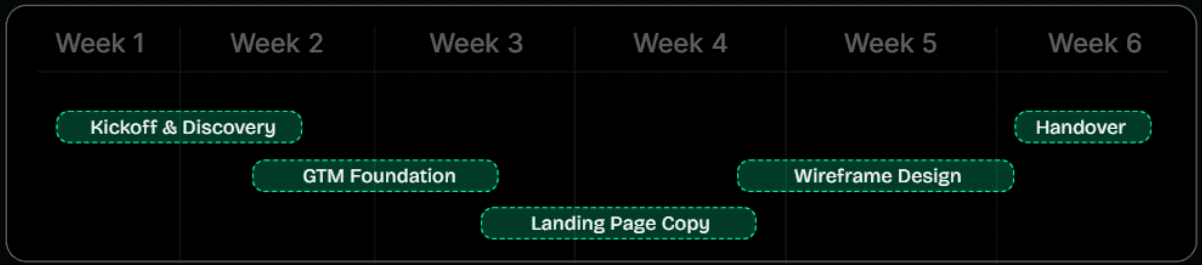
Each phase built on the last. Nothing was written until the strategy was solid.
The Solution
Phase 1: Discovery & Market Understanding
We want to build a data and information design community in India.
Data isn't just numbers, it's a force to drive change.
We want our charts to speak truthfully.

Gurman Bhatia
Founder, Revisual Labs
These weren't taglines. They were the north star: "To see impactful, accessible, and truthful charts everywhere."
We followed that with a competitor benchmarking exercise, analyzing global peers like Information is Beautiful, The Pudding, Accurat Studio, and Pentagram Data Design. This helped us identify the white space where Revisual could stand apart: a focus on accessibility and truth, not just design sophistication.
We also audited previous decks, proposals, and website drafts to identify language inconsistencies and set a baseline for a unified tone of voice.
The finding: Revisual had genuine credibility as a trusted data storytelling studio. They just weren't communicating it in a way that landed.
Phase 2: Building the Strategic Foundation
Before writing a single line of messaging, we needed answers to four fundamental questions:
Who exactly should Revisual be talking to?
What alternatives are clients choosing today, and why?
What specific value does Revisual deliver that others can't replicate?
How should they position each service to different audiences?
These were strategic clarity gaps. Filling them required more than a messaging workshop, it required a Business Strategy Deck that brought together all essential client insights and strategic drivers in one place.
This document became the reference point for everything that followed. It defined who Revisual serves, how they compete, and what they offer across every market segment.
Phase 3: Building the Brand Narrative
With the strategy in place, we built a comprehensive messaging playbook, the single source of truth for how Revisual communicates as a brand.
Brand Messaging
Combining
Art & Science
Tailored
Expertise
Clarifying
Complexity
Establishing
Industry Leadership
Driving
Social Impact
Community -led
Innovation
360* data
offerings
Where creativity
and data work
together
Services tailored
to your goals

Making data easy to understand
Using data to make a difference
Built with and for our community
Setting high standards in data storytelling
A visual overview of the core principles that defines Revisual's approach to data storytelling and impact.
From these pillars, we built out the complete brand messaging foundation: About Us positioning, Mission and Vision statements, six context-specific key messages, five core values, and a six-step process framework from Discovery to Launch.
Persona Messaging
Different buyers need different messages. We developed tailored value propositions for six buyer personas, each grounded in four elements: their pain point, their challenge, their desired impact, and Revisual's specific response.
For example, a Data Scientist struggles to present complex analysis to non-technical stakeholders. They need advanced visualization tools that everyone can understand. Their desired outcome is increased stakeholder engagement and reduced time-to-insight. Revisual's message: "We design impactful visualizations that convey complex data insights simply, and are understood by all."
Every persona message was tailored to their specific needs while staying rooted in the same brand pillars.
Service Messaging
We reframed Revisual's two core offerings with specificity — so prospects could immediately understand the scope of what they do:
Data Visualization — a spectrum across print, digital, and physical mediums: interactive microsites, dashboards, visual essays, charts, reports, infographics, publications, ad campaigns, product design, events, and installations.
Data Training — interactive learning experiences: workshops (hands-on modules) and webinars (virtual sessions).
Every service was explicitly connected back to a brand pillar, so the messaging always reinforced the same coherent story.
Phase 4: Bringing the Story to Life
With the messaging foundation in place, we moved to execution.
Using the StoryBrand 7-Part Framework, we rewrote the homepage and about page copy and created multi-device wireframes. Every copy line and message pillar was then evaluated against Flip HQ's 3C Model — Clarity, Consistency, Credibility. Only messages that passed all three criteria made it into the final deliverables.
For the homepage, we structured the experience to lead with Revisual's core promise. For the about page, we humanized founder Gurman Bhatia's story — converting her journalism roots into a credible founding narrative that explained why Revisual exists and why that matters to clients.
Every word and design choice reflected Revisual's purpose, services, and differentiators.
The Outcome





Ready to conquer
your next growth challenge?