What Happens When Your Biggest Differentiator Is Invisible to Prospects?

What Happens When Your Biggest Differentiator Is Invisible to Prospects?

GTM Strategy

GTM Strategy

Website Copy and Wireframes

Website Copy and Wireframes

Product Marketing Ops

Product Marketing Ops

Executive Summar

Executive Summar

Cobalt (now Refold AI) built a genuinely differentiated integration platform but couldn't articulate how they differed from competitors. In 45 days, we defined "Embedded iPaaS" as a distinct category, created a complete GTM foundation, and restructured their website around buyer outcomes.

15+

Core GTM Assets
Delivered

10+

Web Pages Structured
and Written

< 50

Days to complete the whole project

About The Company

About The Company

Cobalt (now Refold AI) is an embedded integration platform (embedded iPaaS) built for B2B SaaS companies.  It is an infrastructure that lets SaaS companies build integrations directly into their product instead of relying on third-party tools.

In a space filled with players with Unified APIs (data aggregators) and traditional iPaaS (workflow and connector tools), Cobalt introduced a solution (embedded iPaaS) designed for product teams who need scalable, reliable, in-app integrations.

The Problem

Category Confusion in a Crowded Market

Category Confusion in a Crowded Market

Every integration platform seemed to promise the same thing: faster connectivity, less code, better developer experience. But internally, Cobalt's team knew they were building something fundamentally different—an infrastructure layer that let SaaS products own integrations natively inside their app.

The product showed strong promise, but their story had three critical gaps:

No clear category position
The market understood "Unified APIs" and "traditional iPaaS," but had no language for embedded integration infrastructure. Without category clarity, prospects compared Cobalt against whoever they'd evaluated first, regardless of fit.

Messaging that didn't match the buyer
Product managers, engineering leaders, and founders each cared about different outcomes (speed vs. control vs. differentiation), but Cobalt's messaging spoke to all of them generically.

Technical architecture buried business value
The homepage led with how the platform worked instead of what problems it solved. Prospects bounced to competitors with clearer positioning before understanding Cobalt's differentiation.

We want to define this category before someone

else does

Jugal Anchalia

Co-Founder & CEO, Cobalt (now Refold AI)

The urgency was clear: help articulate who they are, how they're
different, and why the category matters.

Key Objective

Key Objective

Create a clear, consistent GTM foundation that would help Cobalt define their category and stand out in a crowded market. Specifically:

Define Cobalt's distinct position between Unified APIs and traditional iPaaS, establishing "Embedded iPaaS" as a recognized category

Create a messaging framework that unifies how different personas (product, engineering, sales, marketing) talk about Cobalt's value

Build a conversion-driven homepage and feature pages that immediately communicate differentiation to technical and business buyers

Equip teams with repeatable frameworks for sales conversations, content creation, and campaign execution, reducing dependency on external resources

These objectives guided every decision, ensuring we built clarity before creating any tactical assets.

The Solution

The Solution

The Solution

Define the Category, Then Build the Story

Define the Category, Then Build the Story

We needed to define the differentiation in simpler terms first, then build a complete GTM foundation around it. So, we structured the engagement in a way that solved the value proposition problem before touching any tactical assets and going beyond.

We needed to define the differentiation in simpler terms first, then build a complete GTM foundation around it. So, we structured the engagement in a way that solved the value proposition problem before touching any tactical assets and going beyond.

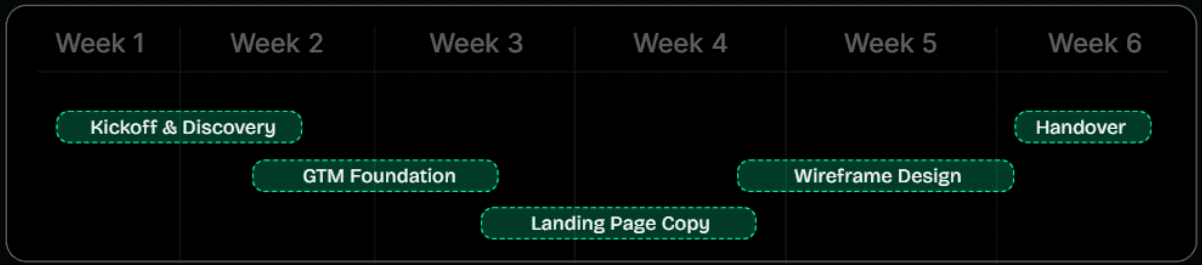
Project Timeline

Project Timeline

Discovery & Category Analysis

Category Definition & Positioning

Messaging Hierarchy

Designing the Experience

Handover

Week 1

Week 2

Week 3

Week 4

Week 5

Week 6

Discovery & Category Analysis

Category Definition & Positioning

Messaging Hierarchy

Designing the Experience

Handover

Week 1

Week 2

Week 3

Week 4

Week 5

Week 6

The project timeline divided into five phases spread across six weeks.

The project timeline divided into five phases spread across six weeks.

1. Discovery & Category Analysis

We ran deep-dive workshops with founders and the product team and reviewed previous decks, proposals, and website drafts. It helped understand Cobalt's market position and articulation challenges.

We ran deep-dive workshops with founders and the product team and reviewed previous decks, proposals, and website drafts to understand Cobalt's market position and where we could improve the messaging

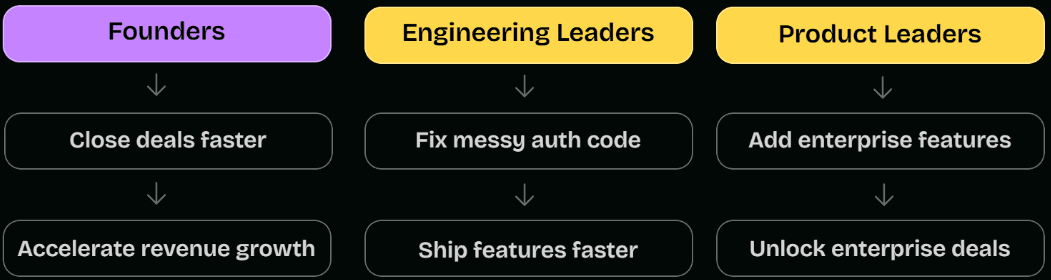
We also identified the recurring key outcomes “jobs-to-be-done” for product and engineering leaders are trying to achieve. We found:

We also identified the recurring “jobs-to-be-done” for product and engineering leaders. We found:

Three personas, three different jobs

Three personas, three different jobs

Founders

Product Leaders

Build defensible competitive advantage

Ship features, not fix integrations

Unlock enterprise buyers

Differentiate with native integrations

Avoid maintenance debt and brittle code

Add integrations without slowing roadmap

Founders

Engineering Leaders

Product Leaders

Build defensible competitive advantage

Ship features, not fix integrations

Unlock enterprise buyers

Differentiate with native integrations

Avoid maintenance debt and brittle code

Add integrations without slowing roadmap

JTBD mapping showed each persona had different motivations to use an Embedded iPaaS.

Each persona needed Cobalt for different reasons, but existing messaging treated them as one undifferentiated audience. This fragmentation was killing conversion.

2. Category Definition & Positioning

We created a three-way comparison that showed exactly where Cobalt fit in the market:
Unified APIs
(e.g., Merge)

Traditional iPaaS
(e.g., Workato)

Embedded iPaaS
(Cobalt)

Primary Use

Pull data from multiple sources into standardized format

Connect apps for internal operations

Build native integration infrastructure into your product

Integration
Ownership

Limited, standardized fields only

Backend workflows, not product-facing

Full control with embedded UX

Best For

Quick connectivity with standard data models

Powerful automation for internal teams

SaaS companies building integrations as product features

Trade-off

Speed at the cost of customization

Power but not designed for end-user experience

Development investment upfront for long-term control

Unified APIs
(e.g., Merge)

Traditional iPaaS
(e.g., Workato)

Embedded iPaaS
(Cobalt)

Primary Use

Pull data from multiple sources into standardized format

Connect apps for internal operations

Build native integration infrastructure into your product

Integration
Ownership

Limited, standardized fields only

Backend workflows, not product-facing

Full control with embedded UX

Best For

Quick connectivity with standard data models

Powerful automation for internal teams

SaaS companies building integrations as product features

Trade-off

Speed at the cost of customization

Power but not designed for end-user experience

Development investment upfront for long-term control

This comparison accomplished three things:

Acknowledged real trade-offs instead of claiming superiority everywhere (credibility)

Showed where each approach makes sense (not just "we're better")

Positioned Cobalt for a specific buyer (product teams building native integrations as features)

We coined the positioning statement:

"Cobalt is the Embedded iPaaS for B2B SaaS companies building native, scalable, secure integrations end-to-end."

This phrase separated Cobalt from data aggregators and workflow automation, establishing "Embedded iPaaS" as a distinct category. It became our north star—every asset, every page, every conversation would reinforce this distinction.

3. Messaging Hierarchy

With category clarity established, we built a messaging framework that connected persona-level jobs to specific product capabilities:

Brand Promise: Own your integrations end-to-end

Positioning: An embedded iPaaS that combines the control of in-house builds with the scalability of managed infrastructure

Three Core Benefits:

Accelerate Development

Reduce Maintenance Debt

Deliver Native Experience

Build integrations 5-10x faster with pre-built connectors and templates

Offload API updates, error handling, and scaling to managed infrastructur

Integrations feel built-in to your product, not bolted-on with third-party tools

Accelerate Development

Reduce Maintenance Debt

Deliver Native Experience

Build integrations 5-10x faster with pre-built connectors and templates

Offload API updates, error handling, and scaling to managed infrastructur

Integrations feel built-in to your product, not bolted-on with third-party tools

Each benefit mapped directly to a persona's job-to-be-done, giving sales a repeatable way to tailor conversations based on who they were speaking with.

4. GTM Asset Creation

To make the category distinction tangible in sales conversations and marketing materials, we created repeatable frameworks:

a. Integration Lifecycle Framework
A before/after comparison showing how Cobalt transforms each stage of the integration lifecycle:

Stage

Objective

Before Cobalt

After Cobalt

Build

Create stable integrations quickly

Manual data mapping, authentication issues, inconsistent field structures, long development cycles

Pre-built connectors, unified schema, dynamic field mapping, 5–10× faster setup

Deploy

Launch and test integrations

Manual staging, error-prone deployment, limited observability

Automated staging, monitoring tools, rollback controls

Maintain

Keep integrations updated

Ongoing API changes, brittle code, repeated QA cycles

Managed updates, fault tolerance, 70% reduction in maintenance load

Govern

No unified dashboards, limited security monitoring

Ensure reliability & visibility

Centralized logs, user-level access control, observability dashboards

This table became a core sales conversation tool, prospects could immediately identify where their current approach was breaking and see how Cobalt solved it.

b. Use Case Reference Story

We built a concrete example: A Sales Intelligence Platform (like Apollo) integrating with HubSpot.

This scenario demonstrated Cobalt's value without technical jargon:

Requirement templates save 2-3 weeks of scoping and documentation

Visual workflow builder eliminates back-and-forth with engineering teams

Built-in monitoring catches errors before customers report them

Automated updates handle HubSpot API changes without manual intervention

Sales teams could now walk prospects through a relatable scenario instead of explaining abstract infrastructure concepts.

c. Competitive Positioning Frameworks

Using detailed competitive analysis, we mapped Cobalt's differentiation against Merge, Paragon, Workato, and Pandium across:

Feature comparison (what each platform actually offers)

Messaging tone (how competitors position themselves)

Technical depth (level of control and customization available)

These frameworks gave sales clear, honest answers when prospects asked "how are you different from X?"

5. Website Restructure & Design

With messaging and frameworks finalized, we restructured the homepage and 10 supporting pages. Every page was built for two goals: understanding and conversion.

We designed low-fidelity wireframes for the homepage and 10+ supporting pages. Every page was built for two things: understanding and conversion.

Homepage narrative flow:

We designed low-fidelity wireframes for the homepage and 10+ supporting pages. Every page was built for two things: understanding and conversion.

Step

Purpose

Content

1. Lead with Problem

Create tension

Integration debt slows product velocity and creates maintenance burden

2. Introduce the Shift

Define category

Embedded infrastructure vs. external tools

3. Show the Payoff

Quantify value

Speed (5-10x faster), Reliability (70% less maintenance), Native experience (embedded in product)

4. Prove It

Build credibility

Lifecycle comparison, use case walkthrough, customer testimonials

Feature pages organized by lifecycle stage (Build/Deploy/Maintain), combining technical credibility with clear business outcomes for each persona.

We designed low-fidelity wireframes for the homepage and 10+ supporting pages. Every page was built for two things: understanding and conversion.

Use case pages led with relatable examples (Apollo + HubSpot) instead of generic feature lists, making the value immediately tangible.

We designed low-fidelity wireframes for the homepage and 10+ supporting pages. Every page was built for two things: understanding and conversion.

We designed low-fidelity wireframes for all pages, ensuring technical buyers could learn without feeling sold to, while business buyers could immediately see ROI.

We designed low-fidelity wireframes for the homepage and 10+ supporting pages. Every page was built for two things: understanding and conversion.

The Impact

The Impact

The Impact

Conversion
We simplified how prospects understood Cobalt's value.
Website visitors could understand the differentiation within seconds.

Conversion
We simplified how prospects understood Cobalt's value.
Website visitors could understand the differentiation within seconds.

Alignment
We created unified messaging system that brought clarity across teams

Product, marketing, and founders finally shared one clear definition of Cobalt and why it matters. The messaging playbook became an onboarding manual for new hires.

Alignment
We created unified messaging system that brought clarity across teams

Product, marketing, and founders finally shared one clear definition of Cobalt and why it matters. The messaging playbook became an onboarding manual for new hires.

Velocity
We accelerated GTM execution with ready-to-use frameworks.
Sales and content teams moved faster on launch materials and campaigns. They had a clear story and a repeatable narrative structure to work from.

Velocity
We accelerated GTM execution with ready-to-use frameworks.
Sales and content teams moved faster on launch materials and campaigns. They had a clear story and a repeatable narrative structure to work from.

Recognition
We established "Embedded iPaaS for SaaS builders" as a category marker.
The phrase became repeated in prospect calls and partner discussions. The frameworks we built laid the groundwork for the company's evolution into what's now known as Refold AI.

Enablement
We helped reduce external

dependency
Messaging guidelines enabled independent content creation and reduced dependency on external resources

"

Flip HQ helped us bring structure and language to something we’d been trying to explain for months. Their work didn’t just improve our website, it changed how we talk about our product internally.

Abhishek kumar, Jugal Anchalia | Founders

Cobalt (now Rrefold AI)

  • 15+

    Core GTM Assets
    Delivered

  • 10+

    Web Pages Structured and Written

  • < 50

    Days to complete the whole project

Company Name

Company Name

Cobalt (now Refold AI)

Revisual Labs

Industry

Industry

B2B SaaS

Revisual Labs

Category

Category

iPaaS (Integration Platform as a Service)

Revisual Labs

Target Market

Target Market

B2B SaaS Apps

Revisual Labs

GTM motion

GTM motion

Product-led sales (PLS), Sales-led growth (SLG)

Revisual Labs

Tools Used

Tools Used

Company Name

Cobalt (now Refold AI)

Website

Industry

B2B SaaS

Category

iPaaS (Integration Platform as a Service)

Target Market

B2B SaaS Apps

GTM motion

Product-led sales (PLS), Sales-led growth (SLG)

Tools Used

© 2026 Flip Funnel. All rights reserved | Full Funnel Digital Private Limited

Follow us on

© 2025 Flip Funnel. All rights reserved
Full Funnel Digital Private Limited

Follow us on